Rigid crates for the hold
Airline pet crates: sizes 100 to 500
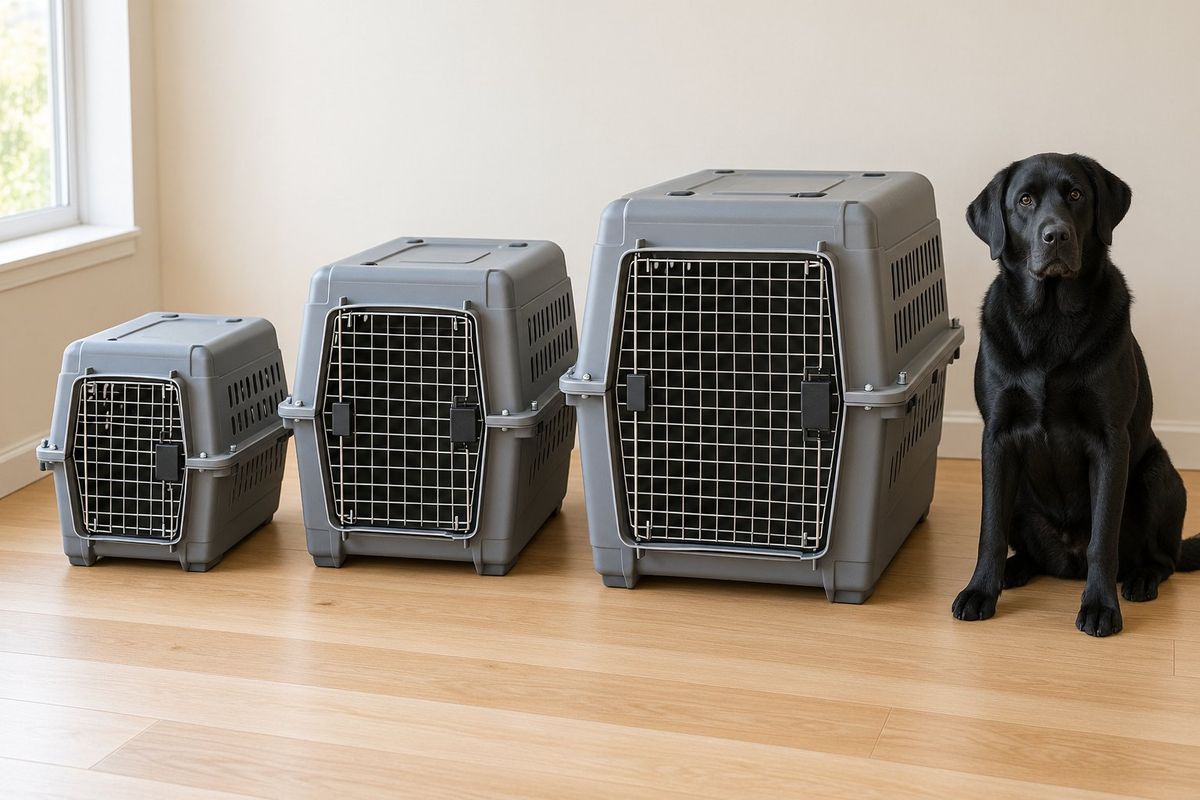
Pets in the hold fly in a hard airline crate. Alaska Air Cargo takes five standard sizes, the 100 to 500 series, from 21 to 40 inches long. Here are the sizes in inches and pounds, a typical size by breed, how we choose yours, and what the cargo counter checks. When we move your pet, we can supply the crate as part of the move.
Sizes
Alaska Airlines crate sizes
Alaska Air Cargo accepts five standard sizes, from the 100 series up to the 500 series. Since the scale reads pet and crate as one, what the empty crate weighs matters as well.
| Series | Outside (L x W x H) | Empty crate | Pet weight guide (Petmate's, for its Sky Kennel) |
|---|---|---|---|
| 100 series | 21 x 16 x 15 inches | 9 lb | up to 15 lb |
| 200 series | 27 x 20 x 19 inches | 14 lb | up to 30 lb |
| 300 series | 32 x 22 x 24 inches | 20 lb | up to 50 lb |
| 400 series | 36 x 24 x 26 inches | 24 lb | up to 70 lb |
| 500 series | 40 x 27 x 30 inches | 28 lb | up to 90 lb |
Measurements decide the size first. When your pet weighs more than that size's guide allows, we move up to the size whose guide covers that weight. The limit for pet plus crate is 150 lb.
Bigger than the 500 series? Pets that outgrow the 500 series get a custom quote. Mention it on the quote form and we will look into what is possible.
Sizing
How we pick the minimum crate
The rule is simple: your pet stands with head and ears clear of the roof, turns in a full circle, and lies down in a normal position. To check that, IATA's container requirements use four measurements of your pet on all fours:
- Length on the inside: A (nose to tail base) plus half of B (floor to elbow), or more.
- Width: double C (shoulders or the widest point), or more.
- Height: D (floor to the top of the head or the ear tips, whichever is taller) plus roughly 1.6 inches to allow for bedding.
Home measurements of a squirming pet are rarely spot on, so we build in roughly 0.8 inches of extra room. Next comes the smallest size with enough inside length, width and height. Fall short on any one and we move to the next size. Finally, weight: if your pet is over that size's guide, we step up once more.
Once we have your pet's measurements, the result reads like this:
Suggested minimum crate size: 300 series (32 x 22 x 24 inches)
This crate size is our best guess from the details you gave. A larger crate can turn out to be needed once your pet is measured in person, and the airline has the last word at check-in. We confirm the size with you before ordering.
Treat it as the smallest option and a best guess. Between two sizes? Pick the larger one.
By breed
Typical crate size by breed
This is the typical minimum for an adult of standard size. We take each breed's adult height at the shoulder and weight from its breed standard and run them through the same rules as our calculator: the weight against each series' pet weight guide, and the shoulder height, plus room for bedding, against the inside height. A dog's head sits higher than its shoulders, and the standard gives no body length, so your own dog may need a bigger crate. Measure your pet in the crate size calculator: its result always wins over this chart.
| Breed | Adult size (standard) | Typical crate | Airline notes |
|---|---|---|---|
| Australian Shepherd | 18 to 23 in at the shoulder40 to 65 lb | 300 to 500 series | None |
| BeagleThe 13 to 15 inch variety. Beagles 13 inches and under weigh under 20 lb. | 13 to 15 in at the shoulder20 to 30 lb | 200 or 300 series | None |
| Bernese Mountain Dog | 23 to 27.5 in at the shoulder70 to 115 lb | 500 series or a custom crate | None |
| Border Collie | 18 to 22 in at the shoulder30 to 55 lb | 300 or 400 series | None |
| Boston Terrier | 10 to 12 in at the shoulder12 to 25 lb | Not flown in the hold | Snub-nosed: Alaska, Hawaiian and Horizon do not carry this breed in the hold. See snub-nosed breeds. |
| BoxerMales 65 to 80 lb; the AKC says females weigh about 15 lb less. | 21.5 to 25 in at the shoulder50 to 80 lb | Not flown in the hold | Snub-nosed: Alaska, Hawaiian and Horizon do not carry this breed in the hold. See snub-nosed breeds. |
| Bulldog (English Bulldog) | 14 to 15 in at the shoulder40 to 50 lb | Not flown in the hold | Snub-nosed: Alaska, Hawaiian and Horizon do not carry this breed in the hold. See snub-nosed breeds. |
| Bullmastiff | 24 to 27 in at the shoulder100 to 130 lb | Custom crate | Counts as a mastiff if the health certificate describes it as one, and Alaska does not take mastiffs in the hold. We check with the airline first. |
| Cane CorsoThe AKC gives no weight ("proportionate to height"); the weight is the FCI standard's. | 23.5 to 27.5 in at the shoulder88 to 110 lb | 500 series or a custom crate | Counts as a mastiff if the health certificate describes it as one, and Alaska does not take mastiffs in the hold. We check with the airline first. |
| Cavalier King Charles Spaniel | 12 to 13 in at the shoulder13 to 18 lb | 100 or 200 series | None |
| Chihuahua | 5 to 8 in at the shoulderup to 6 lb | 100 series | None |
| Cocker Spaniel | 13.5 to 15.5 in at the shoulder20 to 30 lb | 200 or 300 series | None |
| Dachshund (standard)Long for its height: measure the length. | 8 to 9 in at the shoulder16 to 32 lb | 200 or 300 series | None |
| Doberman Pinscher | 24 to 28 in at the shoulder60 to 100 lb | 500 series or a custom crate | None |
| French Bulldog | 11 to 13 in at the shoulderup to 28 lb | Not flown in the hold | Snub-nosed: Alaska, Hawaiian and Horizon do not carry this breed in the hold. See snub-nosed breeds. |
| German Shepherd Dog | 22 to 26 in at the shoulder50 to 90 lb | 400 or 500 series | None |
| German Shorthaired Pointer | 21 to 25 in at the shoulder45 to 70 lb | 300 to 500 series | None |
| Golden Retriever | 21.5 to 24 in at the shoulder55 to 75 lb | 400 or 500 series | None |
| Great Dane | 28 to 32 in at the shoulder110 to 175 lb | Custom crate | None |
| Havanese | 8.5 to 11.5 in at the shoulder7 to 13 lb | 100 series | None |
| Labrador Retriever | 21.5 to 24.5 in at the shoulder55 to 80 lb | 400 or 500 series | None |
| Maltese | 7 to 9 in at the shoulderup to 7 lb | 100 series | None |
| MastiffThe standard sets only a lowest height (30 inches and up for males). | 27.5 in and up at the shoulder120 to 230 lb | Not flown in the hold | Snub-nosed: Alaska, Hawaiian and Horizon do not carry this breed in the hold. See snub-nosed breeds. |
| Miniature Schnauzer | 12 to 14 in at the shoulder11 to 20 lb | 100 or 200 series | None |
| Pembroke Welsh Corgi | 10 to 12 in at the shoulderup to 30 lb | 200 series | None |
| Pomeranian | 6 to 7 in at the shoulder3 to 7 lb | 100 series | None |
| Poodle (Miniature) | 10 to 15 in at the shoulder10 to 15 lb | 100 to 300 series | None |
| Poodle (Standard)The standard sets only a lowest height (over 15 inches): measure a tall one. | over 15 in at the shoulder40 to 70 lb | 300 or 400 series | None |
| Pug | 10 to 13 in at the shoulder14 to 18 lb | Not flown in the hold | Snub-nosed: Alaska, Hawaiian and Horizon do not carry this breed in the hold. See snub-nosed breeds. |
| Rhodesian Ridgeback | 24 to 27 in at the shoulder70 to 85 lb | 500 series or a custom crate | None |
| Rottweiler | 22 to 27 in at the shoulder80 to 135 lb | 500 series or a custom crate | None |
| Shetland Sheepdog | 13 to 16 in at the shoulder15 to 25 lb | 200 or 300 series | None |
| Shih Tzu | 9 to 10.5 in at the shoulder9 to 16 lb | Not flown in the hold | Snub-nosed: Alaska, Hawaiian and Horizon do not carry this breed in the hold. See snub-nosed breeds. |
| Siberian Husky | 20 to 23.5 in at the shoulder35 to 60 lb | 300 to 500 series | None |
| Yorkshire Terrier | 7 to 8 in at the shoulderup to 7 lb | 100 series | None |
The snub-nosed notes come from Alaska Airlines' own list. For a few strong breeds Alaska's pages disagree, so we confirm with the airline first. Mixed breeds and doodles have no breed standard, so measure them.
Cats follow the same rules. A cat up to 15 lb is within the weight guide for the 100 series; a heavier or longer cat moves up to the 200 series. Burmese, Exotic Shorthair, Himalayan and Persian cats are snub-nosed, and Alaska does not carry them in the hold.
Height at the shoulder and adult weight come from each breed's page at the American Kennel Club (AKC), which gives the breed standard's numbers, and one weight from the FCI standard; each is listed under Sources. Where the standard gives males and females separately, the range runs from the smallest female to the largest male.
Ready to fly
Your pet's crate, part of the move
What comes with it
- A hard airline crate sized for your pet, anywhere from 100 series to 500 series
- Hardware and metal door inspected
- Absorbent bedding
- Food and water dishes fixed to the door
- "Live Animal" stickers and this-way-up arrows
- Delivered ahead of moving day, giving your pet time to get comfortable
How it works
A crate from us is part of your pet's move. It goes on your quote, and we agree on the size with you before ordering. You keep it after the move.
Own one already? It works if it fits your pet and passes the rules below. Take the outside measurements, pick the matching size on the quote form, and we will review it.
For a week or two ahead of the flight, keep the crate open at home with a blanket your pet knows. A pet that treats the crate as its den tends to fly more relaxed.
Alaska Airlines kennel rules
Staff inspect every crate at the cargo counter. A crate that fails these rules means your pet stays on the ground.
- A hard crate whose halves are joined by metal or plastic nuts and bolts. A frame held only by clips, snaps, zip ties or tape is refused; zip ties on the door are fine where the airline asks for them.
- A solid top, with no wire roof and no top door.
- A single metal door that fastens securely.
- Vent openings, plus handles on the outside.
- Dishes for food and water fixed inside the door.
- Clean, no leaks, and absorbent bedding that is safe for pets.
- Wheels removed, and nothing broken, sharp or patched together.
- Fabric, wire, mesh, cardboard, wicker and collapsible crates are all refused, as are crate covers.
- The words "Live Animal" at least one inch tall, this-way-up arrows, and the name, address and 24-hour phone number for both the sender and whoever collects.
- Flight numbers written on the crate.
A hard crate built to these rules is often called an IATA approved crate, though IATA publishes the container requirements rather than approving crates. Those requirements are part of its Live Animals Regulations. Alaska Air Cargo's Pet Connect page says kennels for trips within the US must meet USDA kennel standards and kennels to or from other countries must comply with the IATA Live Animals Regulations, and Alaska's checked pet page says a kennel "must meet all USDA and IATA carrier requirements". What the cargo counter checks is the list above.
Size on the plane
On its Boeing 737, Embraer E175 and Airbus A321 aircraft, Alaska accepts every size from the 100 series to the 500 series. Between the Hawaiian islands, the limit is the 400 series, and no crate taller than 28 inches. Anything larger than the 500 series has to be cleared with the airline first.
Weight and age
The pet and crate combined can weigh up to 150 lb. Puppies and kittens need to be weaned and 8 weeks old or more.
Airline crates: questions
What makes a dog crate airline approved?
How big a crate does my dog need for a flight?
What is the biggest crate Alaska Airlines takes?
Is a soft carrier OK for flying?
Can I rent a crate from you?
Can two pets fly in one crate?
Sources
Airline and state rules can change, so check the official page before booking.
- Alaska Air Cargo: kennel requirements, read October 14, 2026
- Alaska Air Cargo: Pet Connect guidelines, read October 14, 2026
- Alaska Air Cargo: Pet Connect, read October 14, 2026
- Alaska Airlines: pets in the baggage compartment, read October 14, 2026
- IATA: Live Animals Regulations, read October 14, 2026
- AKC: Australian Shepherd, read November 1, 2026
- AKC: Beagle, read November 1, 2026
- AKC: Bernese Mountain Dog, read November 1, 2026
- AKC: Border Collie, read November 1, 2026
- AKC: Boston Terrier, read November 1, 2026
- AKC: Boxer, read November 1, 2026
- AKC: Bulldog, read November 1, 2026
- AKC: Bullmastiff, read November 1, 2026
- AKC: Cane Corso, read November 1, 2026
- FCI standard 343: Cane Corso Italiano (13.10.2023), read November 1, 2026
- AKC: Cavalier King Charles Spaniel, read November 1, 2026
- AKC: Chihuahua, read November 1, 2026
- AKC: Cocker Spaniel, read November 1, 2026
- AKC: Dachshund, read November 1, 2026
- AKC: Doberman Pinscher, read November 1, 2026
- AKC: French Bulldog, read November 1, 2026
- AKC: German Shepherd Dog, read November 1, 2026
- AKC: German Shorthaired Pointer, read November 1, 2026
- AKC: Golden Retriever, read November 1, 2026
- AKC: Great Dane, read November 1, 2026
- AKC: Havanese, read November 1, 2026
- AKC: Labrador Retriever, read November 1, 2026
- AKC: Maltese, read November 1, 2026
- AKC: Mastiff, read November 1, 2026
- AKC: Miniature Schnauzer, read November 1, 2026
- AKC: Pembroke Welsh Corgi, read November 1, 2026
- AKC: Pomeranian, read November 1, 2026
- AKC: Poodle (Miniature), read November 1, 2026
- AKC: Poodle (Standard), read November 1, 2026
- AKC: Pug, read November 1, 2026
- AKC: Rhodesian Ridgeback, read November 1, 2026
- AKC: Rottweiler, read November 1, 2026
- AKC: Shetland Sheepdog, read November 1, 2026
- AKC: Shih Tzu, read November 1, 2026
- AKC: Siberian Husky, read November 1, 2026
- AKC: Yorkshire Terrier, read November 1, 2026
Last updated November 19, 2026
Leave the crate to us
Tell us your pet's breed and weight in the form, and for a dog the four measurements. We size the crate with you before booking, and it arrives before moving day.