Guide
Moving to Hawaii with a dog or cat
Yes, you can move to Hawaii with your dog or cat, and you can skip the long quarantine. Your pet needs a microchip, two rabies shots, a passing rabies blood test, a 30-day wait and paperwork in the state's hands before it lands. Starting from scratch, plan on about 3 to 4 months.
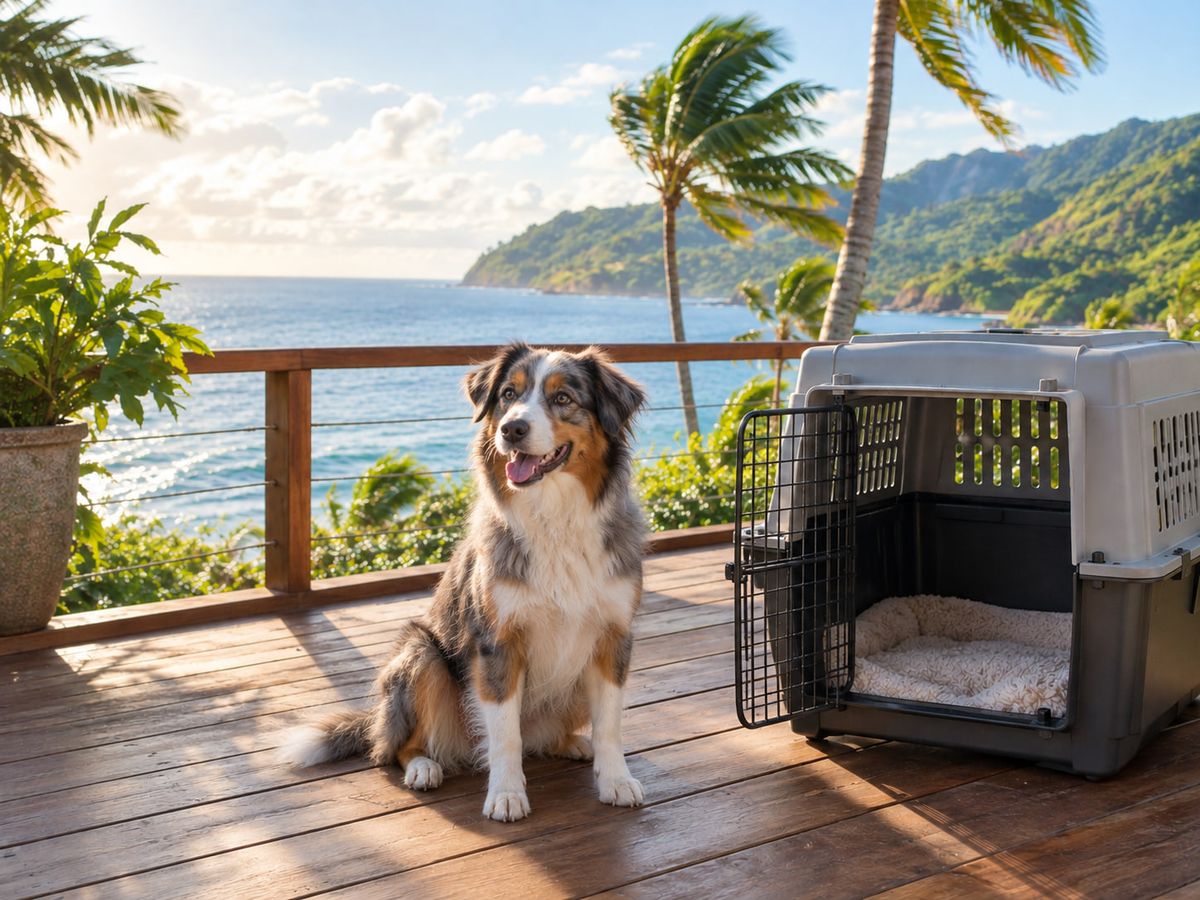
The short answer
- Can I bring my dog?
- Yes. Dogs and cats of any age. Hybrids such as wolf crosses, Bengals and Savannahs cannot enter.
- No quarantine if
- Microchip, two rabies shots more than 30 days apart, a passing OIE-FAVN blood test, 30 days from the day after the lab got the sample, and documents received on time.
- Time to prepare
- About 3 to 4 months from scratch. Weeks, if your pet already has two shots and a passing test from the last 36 months.
- Paperwork due
- At the state 10 days or more before landing in Honolulu. 30 days or more for Kona, Maui (Kahului) or Kauai (Lihue).
- Vet visit
- Health certificate and tick treatment within 14 days before arrival.
- Arrival
- Land in Honolulu by 3:30 pm for same-day release at the airport.
- If it goes wrong
- Up to 120 days at the state quarantine station on Oahu, at your cost.
Which of the four ways into Hawaii fits your dog or cat?
Hawaii is the only rabies-free state, and its Department of Agriculture and Biosecurity (the agency many sites still call HDOA) keeps it that way through its Animal Quarantine Branch. Every dog and cat coming from the mainland ends up in one of four programs. Which one depends on whether your pet meets the requirements, and on time. The state fee for each is under what it costs.
| Program | Where | For a pet that |
|---|---|---|
| Direct Airport Release | Honolulu airport (HNL) | meets every requirement, with documents received 10 days or more before arrival |
| Neighbor Island Inspection Permit | Kona (KOA), Kahului on Maui (OGG), Lihue on Kauai (LIH) | meets every requirement, with documents and a passing test received 30 days or more ahead and a private vet inspector booked |
| 5 Day Or Less | Animal Quarantine Station, Oahu | meets the requirements but is not released at the airport, for example because it landed too late |
| 120-day quarantine | Animal Quarantine Station, Oahu | does not meet the requirements |
What does Hawaii require, and in what order?
These come from Checklist 1 (Honolulu) and Checklist 2 (Kona, Kahului and Lihue), the state's own step lists for dogs and cats. The order matters: a step done too early or too late can cost you months.
1. A working microchip, before the blood test
The microchip has to be in your pet before the blood is drawn for the rabies test, because the lab ties the result to the chip number. Ask your vet to scan an existing chip and check the number on every record. A pet whose chip cannot be read on arrival does not qualify and goes into the 120-day quarantine.
2. Two rabies vaccinations, more than 30 days apart
Your pet needs at least two rabies shots in its life, given more than 30 days apart. The most recent one must be:
- given more than 30 days before arrival, so no rabies shot in the last 30 days before the flight, and
- still current on arrival: 12 months for a 1-year vaccine, 36 months for a 3-year vaccine.
Many adult pets already have two shots on record. If you can only document one, your pet needs a booster first. The state's vet summary says puppies cannot get a rabies shot before 3 months old with current vaccines, and some vaccines for kittens can be given at 2 months.
3. The OIE-FAVN rabies blood test, at an approved lab
Your vet draws blood and sends it to one of four approved labs: Kansas State University, Auburn University, the University of Missouri, or the Department of Defense lab in Texas (open only to people the military allows to use it). The result must be 0.5 IU/ml or more. A few things trip people up:
- The vet must write "HAWAII" as the destination on the lab form. The lab then sends the result straight to the state.
- Hawaii does not accept an RFFIT or the Kansas State "Micro Screen Rabies Screen" test. It has to be the FAVN.
- Sending the sample through a middle lab (such as Antech or Idexx) can delay the date the approved lab receives it, and that date is what counts.
- Blood drawn on the same day as a rabies shot can fail. The University of Missouri lab says about 21 to 30 days after the most recent shot is the best time to draw.
How long results take: the Missouri lab says 7 to 10 business days and the Kansas State lab about 10 to 14 days, while the state warns that results "may be delayed between 1 to 2 months". You can check your pet's result and its earliest arrival date on the state's FAVN result lookup by microchip number; the state updates it weekly, and less often in busy periods. A passing result stays good for 36 months.
4. The 30-day wait
Your pet cannot arrive until 30 days have passed, counted from the day after the lab received the blood sample (not the day of the draw, and not the day of the result). The state is blunt: arriving early means quarantine until the date is reached, and "there are no exceptions".
Some websites, and a couple of older answers on the state's own FAQ page, still mention a 120-day wait after the blood test. The state's current checklists, its information page and its summary for vets all set the wait at 30 days.
5. The import form and documents, sent ahead
You send the state a set of documents, by tracked mail or online through the Hawaii Pet Owner Portal (HIPOP), where you upload them and pay by Visa or Mastercard:
- The Dog and Cat Import Form AQS-279, one per pet. It does not need to be notarized. The legal owner must be named on it: a transport company can be an authorized handler, never the owner.
- The original certificates for the two rabies shots, signed in ink, with the vaccine name, lot or serial number, booster interval, vaccination date and lot expiration date.
- The fee, by cashier's check or money order payable to the Department of Agriculture and Biosecurity (no personal checks), or by card in the portal.
- For Kona, Kahului or Lihue: your flight details and a letter asking for direct release at that airport.
For Honolulu the set must be received 10 days or more before arrival. For the neighbor islands it is 30 days or more, with a passing test already on file. Allow for the mail.
6. Health certificate and tick treatment, within 14 days
In the last 14 days before arrival, a licensed vet examines your pet and issues an original health certificate in English. It shows the rabies vaccine details and the microchip number, and, since the New World screwworm was found in the US on June 3, 2026, the statement "All animals were inspected and found free of evidence of New World Screwworm infestation."
At the same visit, the vet treats your pet for ticks with a long-acting product and writes the product name and date on the certificate. The state names Revolution as not acceptable and keeps a list of accepted active ingredients. Your vet picks the product, since some are for dogs only.
The certificate can travel with your pet if it is not ready when the other documents go. A photocopy is refused, and without the original your pet is not released.
Honolulu, Maui, Kona or Kauai: where should your pet land?
Honolulu (HNL) is the simplest way in. It is the only airport with a state inspection facility, no permit is needed, and the documents are due 10 days before arrival.
Kona (KOA), Kahului on Maui (OGG) and Lihue on Kauai (LIH) take dogs and cats straight from the mainland only with a Neighbor Island Inspection Permit:
- Before you book the flight, contact one of the private vets the state lists for that airport and book the inspection. The vet confirms the booking to the state, and you pay the vet directly.
- The documents, the fee and a passing FAVN result must reach the state 30 days or more before arrival. The state will not issue the permit without a passing result, and it has seen owners miss their flight because the test came back late.
- The permit is emailed to the primary owner on the import form. Print it: the airline needs the paper copy at check-in, and it must be issued for the first airport your pet lands at in Hawaii.
- The inspectors are not based at the airport. If the flight changes, you rebook the inspection yourself; the airline cannot do it for you.
Airlines may not fly a dog or cat from the mainland straight to Kona, Kahului or Lihue without the permit. A pet that arrives on a neighbor island without everything in order is sent to Honolulu, or out of the state, at the owner's cost.
Moving to Maui or the Big Island on a short timeline? Landing in Honolulu first, then flying on after release, needs no permit. The airline does not take kennels over 28 inches on flights within Hawaii, so check the crate before you plan the hop.
Moving to Hawaii with a dog: when do you do each step?
Pick a target arrival date, then work backward. This is the version for a pet with no rabies history. If your pet already has two shots and a passing FAVN test from the last 36 months, start at "30 days before".
| When | What to do |
|---|---|
| 4 months or more before | Vet visit: microchip in (or scanned), first rabies shot if your pet has none on record. Gather every rabies certificate you have. Start getting your pet used to its travel crate. |
| About 3 months before | Second rabies shot, more than 30 days after the first. |
| About 2 to 3 months before | FAVN blood draw, a few weeks after the latest shot, with "HAWAII" on the lab form. Note the day the lab receives the sample: your pet's earliest arrival date is 30 days after the day after that. |
| When the result is in | Check it on the state's lookup. Set the arrival date: after the 30-day wait, more than 30 days after the latest rabies shot, and before that shot expires. |
| 30 days or more before | No rabies shots from here on. Kona, Maui or Kauai: book a listed vet inspector at the arrival airport, then get the import form, rabies certificates, fee, flight details and request letter to the state for the Neighbor Island Inspection Permit. |
| 10 days or more before | Honolulu: the import form, two original rabies certificates and fee must be at the Animal Quarantine Station. Send them earlier than you think you need to. |
| 14 days or less before | Vet visit for the health certificate and the tick treatment. Keep the original certificate with your pet's papers if it did not go with the documents. |
| Travel day | Food and water offered within the last 4 hours, as the airline requires. A flight that lands in Honolulu by 3:30 pm. Neighbor islands: the printed permit in hand at check-in. |
Flying from Seattle to Hawaii: how does your dog or cat travel?
Alaska Airlines and Hawaiian Airlines fly from Seattle to Hawaii, and since their merger they publish one pet policy: Hawaiian's pet page is now the shared Alaska and Hawaiian page. The flight from Seattle to Honolulu is about 6 hours. There are three ways for a pet to fly:
- In the cabin, with you: a small dog or cat in a soft-sided carrier up to 17 x 11 x 9.5 inches, under the seat. Space is limited.
- Checked, in the hold on your flight: dogs and cats only, in a hard kennel, pet and kennel together up to 150 lb.
- On its own, as cargo: through Alaska Air Cargo, in a hard kennel, pet and kennel up to 150 lb. This is the option when you fly on a different day, or want your pet's trip handled for you.
Limits that apply on the airline side:
- Only dogs and cats can fly to Hawaii in the hold or as cargo. Rabbits may fly in the cabin to Honolulu only; birds cannot fly to Hawaii.
- Health certificate: the airline wants one dated no more than 14 days before arrival for any pet flying between the mainland and Hawaii, cabin pets included, plus a rabies certificate for cargo.
- Snub-nosed breeds such as Pugs, Bulldogs, Boxers, Boston Terriers and Shih Tzus, and the cats named under cats, are not accepted in the hold. See snub-nosed breeds and flying.
- Temperature: Pets fly in the cargo hold when the forecast is 85°F or cooler at every airport on the trip. Below 45°F, they also need a vet acclimation letter, issued within 10 days of the flight. Storms can close Hawaii airports to pets at short notice: on July 29, 2026, for example, Alaska Air Cargo took no animals arriving in Honolulu, Lihue, Maui or Kona because of the weather.
- Crate: an airline approved hard kennel with a metal door, nuts and bolts, and no wheels. See airline pet crates for sizes.
- Arrival times: Alaska Airlines and Hawaiian Airlines do not carry dogs, cats or rabbits on flights arriving in Honolulu before 8:00 am or after 10:00 pm.
What does it cost to move a dog or cat to Hawaii?
Three kinds of cost, set by three different parties. These are their published fees per pet; check the source before you pay, because each of them can change its fees without notice. There are no discounts for several pets.
| Who charges | For what | Fee |
|---|---|---|
| State of Hawaii, Animal Quarantine Branch | Direct Airport Release, Honolulu, documents received 10 days or more ahead | $185 |
| Direct Airport Release with documents late or brought on arrival | $244 | |
| Neighbor Island Inspection Permit (Kona, Kahului, Lihue) | $165, plus the private vet inspector's fee | |
| 5 Day Or Less | $244 | |
| Arriving before the eligible date | $14.30 a day plus $244 (capped at $1,082, the figure printed on the import form) | |
| 120-day quarantine | $1,080 | |
| Pet held overnight at the airport and not collected by 10:00 am | $59 extra | |
| Pet left at the station past its release date | $17.80 a day | |
| FAVN lab | OIE-FAVN test at the University of Missouri lab | $79, plus your vet's charge for the blood draw and shipping |
| Your vet | Microchip, rabies shots, blood draw, health certificate, tick treatment | Set by your vet |
| Alaska Airlines and Hawaiian Airlines | Pet in the cabin with you | $100 each way |
| Checked pet in the hold, on your flight | $200 each way | |
| Pet flying on its own as cargo | Priced on the weight of the pet and the crate together |
Pets that return to Hawaii after an earlier release can qualify for a lower re-entry fee of $98 ($130 if the documents are late). The state takes cards and cash at the airport, but paying ahead with the documents is faster.
Hawaii pet travel checklist: is everything ready before your pet flies?
Tick these off before your pet flies. The state's own versions are Checklist 1 for Honolulu and Checklist 2 for Kona, Kahului and Lihue.
- Microchip implanted before the blood draw, scanned and readable, same number on every document.
- Two rabies shots on record, more than 30 days apart, with signed original certificates.
- Latest rabies shot more than 30 days before arrival and still current on arrival day.
- Passing OIE-FAVN result (0.5 IU/ml or more) from an approved lab, with "HAWAII" on the lab form.
- Arrival date at least 30 days after the day after the lab received the sample, and within 36 months of it.
- Import form AQS-279 filled in, with you as the legal owner and anyone collecting your pet listed as co-owner or authorized handler.
- Documents and fee received by the Animal Quarantine Station 10 days or more before arrival (30 days or more for neighbor islands).
- Neighbor islands only: vet inspector booked, permit received by email and printed.
- Original health certificate in English, dated within 14 days of arrival, with the rabies details, the microchip number and the screwworm statement.
- Tick treatment within 14 days of arrival, product and date on the health certificate.
- An airline approved crate.
- A vehicle at the airport big enough to take the crate with your pet inside.
What happens on arrival day in Honolulu?
Airline staff take your pet from the plane to the state's Airport Animal Quarantine Holding Facility, on the service road between the interisland terminal and the main terminal. That includes cabin pets.
- Hours: inspections run from 8:30 am to 4:30 pm every day, weekends and holidays included. The airline can take up to an hour to bring your pet over, which is why the state asks for flights that land by 3:30 pm.
- How long it takes: the state says it generally processes a pet within an hour of receiving it, longer when paperwork was not sent ahead. If you are connecting to another island, it suggests allowing 4 to 5 hours.
- Who can collect: only the owner, a co-owner or an authorized handler named on the import form, or the consignee on the airline's shipping papers, with ID. If you are not flying with your pet, consign it to the person who will collect it.
- Leaving the airport: your pet stays in its crate on airport property. Crates are brought out to the sidewalk in front of the facility, and there are no carts or porters there, so bring a vehicle big enough for the crate with your pet inside.
- Landing late: a pet that misses the inspection hours stays overnight and can be collected the next morning by 10:00 am. After that it moves to the 5 Day Or Less program at the quarantine station.
What can go wrong, and what happens then?
What the state's checklists and FAQ say happens:
| If | Then |
|---|---|
| Your pet lands before the 30-day wait is over, or within 30 days of its latest rabies shot | Held at the quarantine station until it qualifies, at $14.30 a day plus $244. No exceptions. |
| The documents reach the state late, or come with you | Release can be delayed or impossible that day, and the fee rises to $244. |
| The microchip cannot be read | No direct release and no 5 Day Or Less: 120-day quarantine. |
| Only one rabies shot can be documented, or the FAVN test failed or was never done | Your pet does not qualify, and is quarantined for up to 120 days. |
| The original health certificate is missing | Your pet is not released. A photocopy does not count. |
| Ticks or other parasites are found on arrival | No direct release; your pet goes to the quarantine station until it meets the requirements. |
| The flight lands too late for inspection | Overnight at the airport facility. Not collected by 10:00 am: $59 extra, then the 5 Day Or Less program. |
| No valid permit for Kona, Kahului or Lihue | The airline cannot fly your pet there. Arriving without the procedure followed means entry is refused. |
| Your pet is a wolf cross, Bengal, Savannah or another hybrid | It cannot enter Hawaii at all. |
What about cats, puppies, kittens and service dogs?
Cats
Cats follow the same program as dogs, step for step, with the same fees. A cat that qualifies can be released at the airport like a dog. If a cat does have to stay, the station's cat kennels are about 5 by 10 feet, with platforms and a sheltered area, and owners can visit in set afternoon hours. Two breed points for cat owners:
- Bengals and Savannahs count as hybrids and cannot enter Hawaii.
- Persian, Himalayan, Exotic Shorthair and Burmese cats, and their mixes, cannot fly in the hold on Alaska or Hawaiian. They can fly in the cabin with you if the carrier fits under the seat.
Puppies and kittens
Young pets have to follow every step too. The state says a newborn puppy or kitten will be about 6 months old by the time it can meet the requirements; one that cannot is quarantined for 120 days.
Service dogs and emotional support animals
A trained service dog traveling with its handler can be released without quarantine. It needs a current rabies vaccination, a microchip, a passing FAVN test, and a health certificate issued within 30 days of arrival showing a tick treatment within 14 days. The state must have the arrival details at least 24 hours ahead. Emotional support animals are not service dogs under Hawaii's definition and follow the pet program. Since 2019 it has been against state law to misrepresent a pet as a service animal. The details are on the state's guide and service dog page.
Moving from Washington
Hawaii's program is the same from every mainland state, so starting in Seattle changes nothing on Hawaii's side. The screwworm statement is required on every Hawaii health certificate, wherever the pet comes from.
What do we do on a move to Hawaii?
You can do all of this yourself: the steps above are everything the state asks for. If you would rather hand the move over, this is how it splits with us.
What we arrange
- A plan of dates worked backward from your move: shots, blood test, paperwork and vet visit.
- A check of every document against the state's checklist before it goes.
- A ride to your own vet in the Seattle area for the health certificate visit, if you want it.
- The airline crate in the right size, set up for the flight.
- The flight for your pet, on a schedule that lands in time for inspection.
- Home pickup in the Seattle area and check-in at SEA cargo.
- Collection after release in Hawaii and delivery to your new home, with the person collecting listed as authorized handler on your import form.
What stays with you
- Signing the import form AQS-279 as the legal owner.
- Paying the state, the lab and your vet directly.
- For Kona, Maui or Kauai, the booking with the inspecting vet, which the state wants from the owner.
A move with us is quoted per move: the flight, the crate, home pickup in Seattle and delivery in Hawaii, and anything else you ask for. To get a quote, send the quote form with your dates and where your pet stands: rabies shot dates and the FAVN date if there is one. We prepare your quote and email it to you, with the earliest date your pet could fly.
Our Hawaii routes:
Moving back one day? Keep the rabies shots current: a passing FAVN result counts for 36 months, and pets returning to Hawaii can qualify for the lower re-entry fee. Leaving Hawaii for the mainland? See Honolulu to Seattle. Once you land, our guide to helping your pet settle in covers the first days, heat included.
Moving to Hawaii with a dog or cat: questions
Can I take my dog to Hawaii?
How do I move to Hawaii with a dog without quarantine?
How long is quarantine for dogs in Hawaii?
Do cats have to quarantine in Hawaii?
What health certificate does my dog need for Hawaii?
How much does it cost to bring a dog to Hawaii?
Can I bring a service dog or an emotional support dog to Hawaii?
Can my dog fly in the cabin to Hawaii?
Sources
Airline and state rules can change, so check the official page before booking.
- Hawaii Department of Agriculture and Biosecurity: Animal Quarantine Information Page (fees, programs, hours), read October 21, 2026
- Checklist 1: Direct Airport Release and 5 Day Or Less, Honolulu (PDF, June 13, 2023), read October 21, 2026
- Checklist 2: Direct Airport Release at Kona, Kahului and Lihue (PDF, January 17, 2024), read October 21, 2026
- Dog and Cat Import Form AQS-279 (PDF, Rev. 1/24), read October 21, 2026
- Hawaii Pet Owner Portal (HIPOP), read October 21, 2026
- FAVN result lookup by microchip, read October 21, 2026
- Summary for veterinarians AQS-39 (PDF), read October 21, 2026
- Quarantine FAQ (updated October 2, 2026), read October 21, 2026
- FAQ for the 5 Day Or Less program, read October 21, 2026
- List of acceptable tick treatments (updated October 12, 2026), read October 21, 2026
- Guide and service dogs entering Hawaii, read October 21, 2026
- University of Missouri One Health-Rabies Laboratory (FAVN fee and turnaround), read October 21, 2026
- Kansas State University: FAVN test for pet travel (turnaround), read October 21, 2026
- Alaska Airlines and Hawaiian Airlines: pets traveling to Hawaii, read October 21, 2026
- Alaska Airlines and Hawaiian Airlines: pets in the cabin, read October 21, 2026
- Alaska Airlines and Hawaiian Airlines: pets in the baggage compartment, read October 21, 2026
- Alaska Air Cargo: Pet Connect guidelines, read October 21, 2026
- Alaska Air Cargo: Pet Connect restrictions, read October 21, 2026
- The airlines' published schedules, Seattle to Honolulu (flight time), read October 2026
Last updated November 19, 2026
Moving to Hawaii with your pet?
Tell us your dates and where your pet stands with the rabies steps. We plan the timeline with you, arrange the move from Seattle door to door, and email your quote.